FEU-35-1 Photomultiplier Tube — Overview & Applications
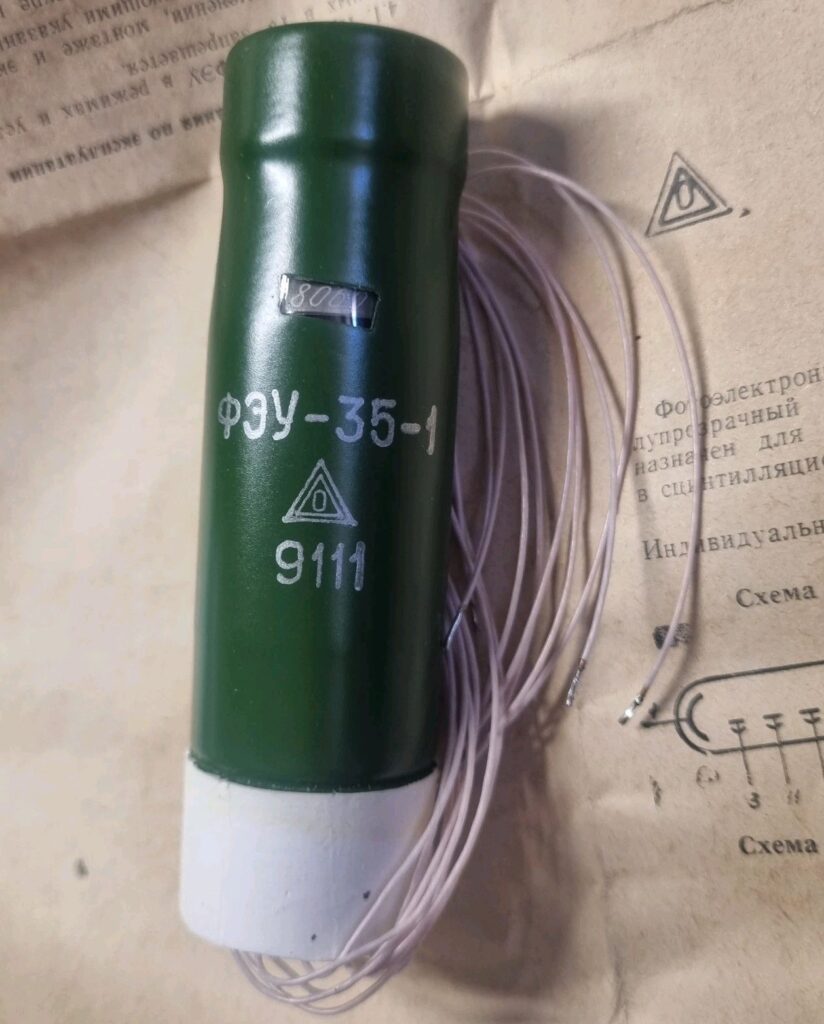
The FEU-35 is a Soviet-era photomultiplier tube designed for radiation detection and low-light sensing.
It features a 25 mm diameter photocathode and a glass envelope without a socket connector, it rather have flexible leads optimized for coupling with scintillators in compact detector assemblies.
Key Characteristics
- Spectral sensitivity: peak response in the UV–blue region, approximately 340–440 nm.
- Photocathode: antimony–cesium (Sb–Cs) type for efficient UV response.
- Electron multiplier: 8-stage dynode chain providing high gain.
- Operating voltage: up to about 1.6–1.75 kV supply but typical use is at 1000-1250V.
- Typical anode current: < 50 µA in normal operation.
- Dark current: low, suitable for weak-signal measurements.
- Form factor: compact tube, approx. 113 mm length, ~50 g mass.
Typical Use Cases
- Gamma spectroscopy – coupled with NaI(Tl) or CsI(Tl) crystals for energy-resolved radiation measurements.
- Scintillation counters – general-purpose radiation detection in portable or laboratory instruments.
- Soft X-ray detection – especially with the FEU-35A version.
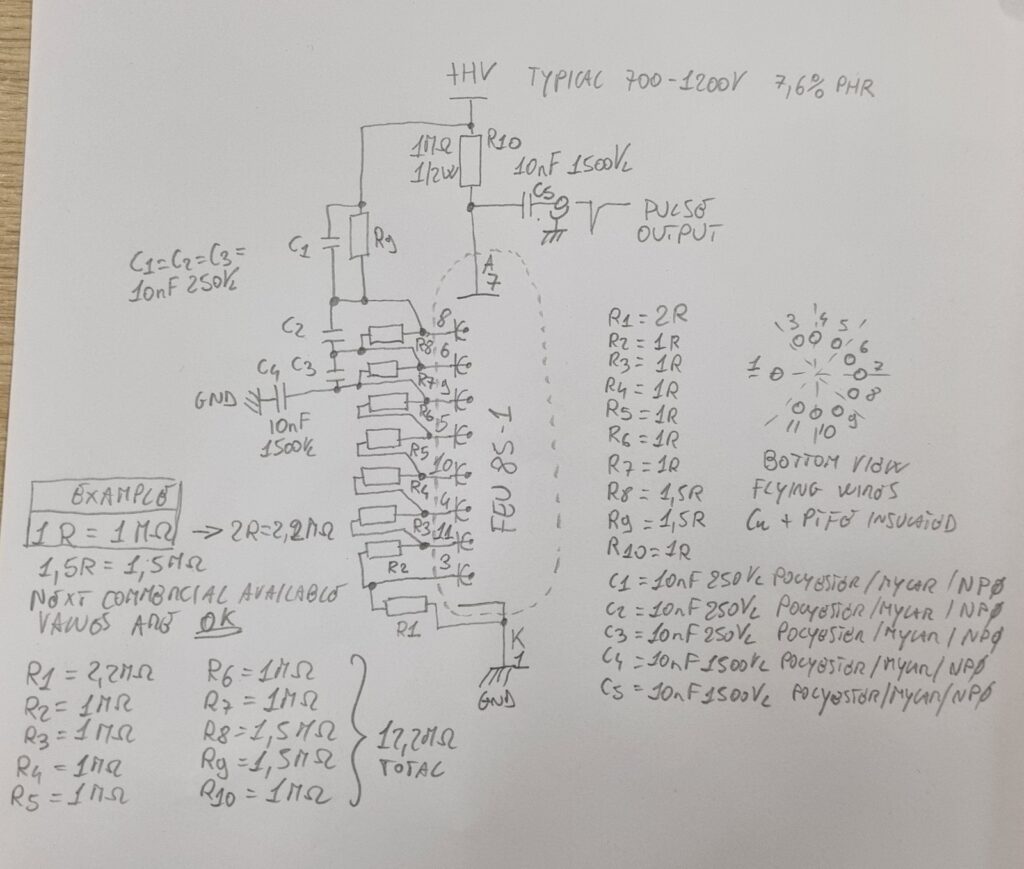
The following picture is a schematic for FEU35-1 voltage divider chain, quick draft on a piece of paper. It simply should work perfectly.
Why It’s Still Interesting Today
Vintage PMTs like the FEU-35-1 offer good sensitivity and reliability at relatively low cost, which makes them popular for DIY gamma spectrometry projects, academic periments, and the restoration of older nuclear instrumentation.